Kiva Systems (now Amazon Robotics) · working robot
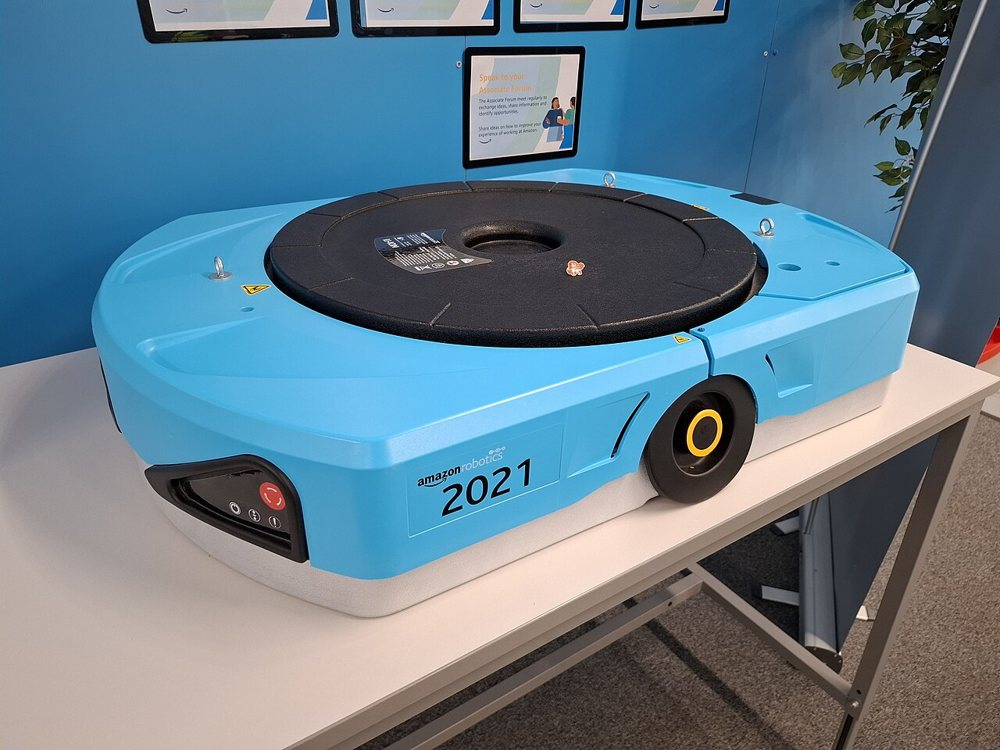
Kiva drive unit
A low, square robot that slides under a shelving pod, lifts it and drives it to a human picker by following barcodes on the floor. The smaller model lifted about 1,000 lb and a larger pallet model about 3,000 lb; top speed was 1.3 m/s.
- Price
- —Not sold separately after 2012; Amazon bought Kiva for about $775 million in cash
- Height
- —Not published
- Weight
- —Not published
- Payload
- 454 kgCarries more than 62%
- Speed
- 4.7 km/hFaster than 47%
- Battery
- —Not published
Not sure this is the one? Find the best robot for your job Starts with: move boxes or carts. Five more quick questions.
Why it matters
Its robots popularised the goods-to-person warehouse model in which squat robots carry whole shelving pods to a seated picker.
Real-world use
Used by retailers such as Gap, Walgreens and Staples before Amazon bought Kiva in 2012 and stopped outside sales.
Timeline
- Released
- 2012-03
Maker
Kiva Systems (now Amazon Robotics)Company · founded 2003 · North Reading, Massachusetts, USAHow it stacks up
Against other working & field robots that publish the figure. Pick a measure.
Kiva drive unit is faster than 47% of the 86 other working & field robots that publish a speed. Bars show the 7 closest in date.
Kiva drive unit carries more than 62% of the 84 other working & field robots that publish a payload. Bars show the 7 closest in date.
Not published by the maker: height, weight, joints, battery, price.
Public attention
A historic robot: no longer sold or in use, so it is not ranked against current machines.
- No Wikipedia article of its own yet
- 1 news story from reputable press listed on this page
- 1 reported deployment
Measures how much people read and write about a robot, not how good it is. Measured 2026-10-14; same method for every robot. How it is measured
What’s inside
The parts the company has talked about publicly.
- Movement
- Wheeled base
- How it runs
- Fully autonomous. Directed by central software, it found, lifted and delivered shelving pods by itself, following floor barcodes.
- Actuators & motors
- Battery-powered drive unit that slides under a storage pod and lifts it with a corkscrew action; top speed about 1.3 m/s.
- Sensors & vision
- Reads bar-code stickers on the floor for navigation; collision-avoidance sensor.
- Battery & power
- Recharged for about five minutes each hour.
- AI & software
- Central Kiva software assigns the nearest robot to fetch the pod holding each ordered item and bring it to a picker.
- Other details
- Two models: a small unit (about 0.6 x 0.76 m, 46 cm tall) lifting 450 kg, and a larger unit carrying pallets up to about 1,400 kg. Distinctive orange.
From the maker
Kiva drive unit is the only machine from Kiva Systems (now Amazon Robotics) in the atlas.
Made, sold and where
Unit counts are usually company figures; analysts often disagree.
- Price
- Not publishedNot sold separately after 2012; Amazon bought Kiva for about $775 million in cash
- How to get one
- No official buying page found
- Built
- Not disclosed; Amazon reported more than 200,000 warehouse drives by 2019 (descendants included)
- Sold or delivered
- Sold to outside retailers until Amazon bought Kiva for about $775 million (deal announced 19 March 2012); outside sales then stopped
- Where it is sold or used
- Kiva Systems, North Reading, Massachusetts
- Customers and pilots
- Gap, Walgreens, Staples, Gilt Groupe, Office Depot, Crate & Barrel, Saks Fifth Avenue, Amazon
Where it works
1 reported deployment.
- Trial ended
Gap, Walgreens, Staples and others
Retailers such as Gap, Walgreens and Staples used Kiva robots before Amazon bought the company. IEEE Spectrum
News
The latest 1, newest first. Summaries are ours; tap through for the original.
- Amazon to buy Kiva Systems
Amazon announced it would acquire Kiva for about $775 million in cash, keeping its headquarters in North Reading.
Amazon.com (via SEC filing)
Sources
Figures come from press coverage. Every link below backs something on this page.
Photos and logos only identify each robot and its maker. Simbeing is not affiliated with, sponsored by or endorsing any company, and nothing here is advertising. Figures are for statistics only and are not advice of any kind. Terms of use