MIT Humanoid Robotics Group (MIT Artificial Intelligence Laboratory) · research humanoid
Cog
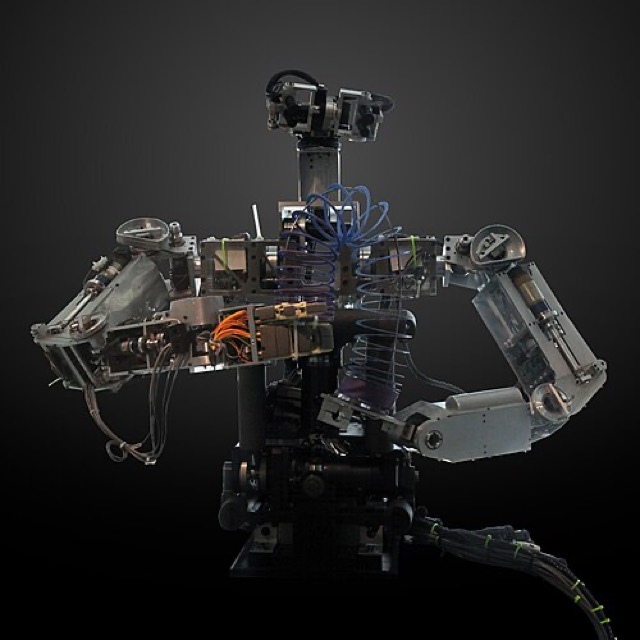
A fixed upper-torso humanoid with a head, eyes and arms, built at MIT to test 'embodied' learning ideas. Development stopped by 2003 and Cog is now at the MIT Museum.
- Price
- —Not published
- Height
- —Not published
- Weight
- —Not published
- Payload
- —Not published
- Speed
- —Not published
- Battery
- —Not published
Not sure this is the one? Find the best robot for your job Starts with: research and teaching. Five more quick questions.
Why it matters
An influential early upper-body humanoid used to study how a robot could learn through embodiment, like an infant.
Real-world use
MIT Museum (retired)
Timeline
- First shown
- 1993
- Released
- Not yet
Maker
MIT Humanoid Robotics Group (MIT Artificial Intelligence Laboratory)University lab · founded 1993 · Cambridge, United StatesPublic attention
A historic robot: no longer sold or in use, so it is not ranked against current humanoids.
- 722 views of its Wikipedia article in the last 90 days (Cog (project))
- 3 news stories from reputable press listed on this page
Measures how much people read and write about a robot, not how good it is. Measured 2026-10-14; same method for every robot. How it is measured
What’s inside
The parts the company has talked about publicly.
- Hands
- simple
- Movement
- Stationary
- Actuators & motors
- Series elastic actuators in the arms and DC gearmotors in the chest; 22 degrees of freedom (arms 6 each, torso 3, neck 4, eyes 3).
- Sensors & vision
- Two cameras per eye (wide and narrow field of view), a three-axis inertial system, load cells in each joint, optical encoders, a tactile sensor array, two microphones, and limit, pressure and thermal sensors.
- Battery & power
- External power supply; fixed on a pedestal (172 cm tall including pedestal).
- Materials & build
- A lab prototype.
- AI & software
- Research goal: a general system that learns links between motor commands and sensory input, as a model of human development.
From the maker
Cog is the only humanoid from MIT Humanoid Robotics Group (Rodney Brooks, Lynn Andrea Stein) in the atlas.
Made, sold and where
Unit counts are usually company figures; analysts often disagree.
- Price
- Not published
- How to get one
- No official buying page found
- Built
- One.
- Sold or delivered
- Never sold.
- Where it is sold or used
- United States
- Customers and pilots
- MIT Museum (retired)
News
The latest 3, newest first. Summaries are ours; tap through for the original.
- Cog transferred to the MIT Museum
CSAIL transferred Cog to the MIT Museum in January 2004; it was accessioned late that month and prepared for a traveling exhibition loan.
MIT Museum - Bringing Up RoboBaby
David H. Freedman profiles Cog and Rodney Brooks's approach to developing robot intelligence through bodily experience.
WIRED - Building Brains for Bodies
Rodney Brooks and Lynn Andrea Stein propose an integrated embodied system to investigate human cognition at the MIT Artificial Intelligence Laboratory.
MIT Artificial Intelligence Laboratory
Side by side with its peers
Picked by the same rules for every humanoid: another maker’s robot that moves the same way, is at the same stage and does at least one of the same main jobs, first shown within two years. Closer size and price rank higher. Few robots match closely, so these are the nearest matches. How we choose
| Measure | CogMIT Humanoid Robotics Group (Rodney Brooks, Lynn Andrea Stein) | No public photo yetWe only show photos we're allowed to useSaikaUniversity of Tokyo (Inoue-Inaba lab)Same job: research · Both fixed in place · Both past robots |
|---|---|---|
| First shown | 1993 | 1996 |
| Status | Retired | Retired |
| Height | — | — |
| Weight | — | 8 kg |
| Joints | — | — |
| Speed | — | — |
| Payload | — | — |
| Battery | — | — |
| Price | — | — |
Sources
Figures come from public sources. Every link below backs something on this page.
Photos and logos only identify each robot and its maker. Simbeing is not affiliated with, sponsored by or endorsing any company, and nothing here is advertising. Figures are for statistics only and are not advice of any kind. Terms of use