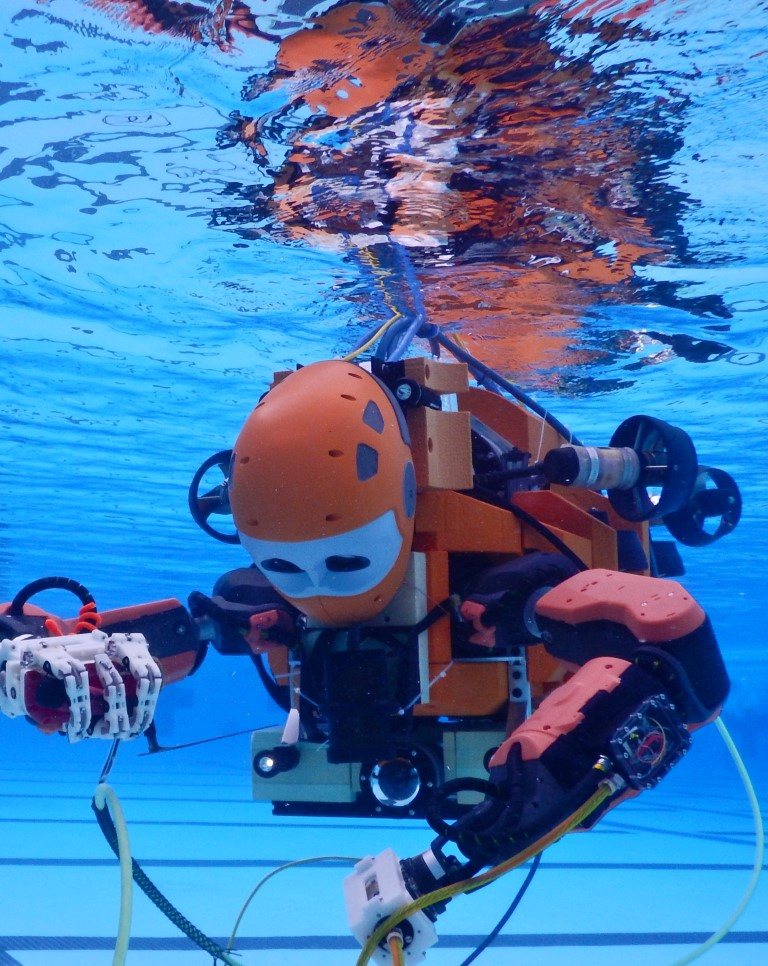
Stanford Robotics Lab (Oussama Khatib), Stanford University · research humanoid
OceanOne
An underwater robot with a humanoid torso, two arms and three-fingered hands on a thruster-driven 'tail', teleoperated with stereo vision and haptic feedback. Locomotion is by thrusters (recorded as static).
- Price
- —Not published
- Height
- —Not published
- Weight
- —Not published
- Payload
- —Not published
- Speed
- —Not published
- Battery
- —Not published
Not sure this is the one? Find the best robot for your job Starts with: research and teaching. Five more quick questions.
Why it matters
First humanoid diving robot to explore a shipwreck, recovering a vase from King Louis XIV's flagship La Lune.
Real-world use
Dove to the La Lune wreck off southern France in April 2016.
Timeline
- Released
- Not yet
Maker
Stanford Robotics Lab (Oussama Khatib), Stanford UniversityUniversity lab · Stanford, United StatesWhat it has been shown doing
1 of 14 skills we track, each from a public video or report. Demos can be staged or remote-controlled; we say so when the source does.
- Fine dexterityteleoperated with haptic feedback to recover a delicate vase from the La Lune shipwreck · Apr 2016 · spectrum.ieee.org
Not shown yet:SortAssembleFoldKitchenToolsStairsTerrainGet upRunJumpCarryOn siteAutonomous
Public attention
How much public attention OceanOne gets, from open data.
- No Wikipedia article of its own yet
- 2 news stories from reputable press listed on this page
Measures how much people read and write about a robot, not how good it is. Measured 2026-10-14; same method for every robot. How it is measured
What’s inside
The parts the company has talked about publicly.
- Movement
- Stationary
- Actuators & motors
- Eight thrusters for the body; two fully articulated arms that automatically adjust to keep the hands steady as the body drifts.
- Hands
- Three-fingered hands (IEEE Spectrum) with force sensors whose readings are passed to the pilot as touch.
- Sensors & vision
- Stereoscopic cameras plus force sensors in the hands.
- AI & software
- Haptic telepresence: the pilot uses haptic joysticks to feel the weight of held objects and can communicate with gestures.
- Other details
- About 1.5 m long end to end, a hybrid of humanoid and underwater remotely operated vehicle; first worked at about 100 m depth.
From the maker
OceanOne is the only humanoid from Stanford University (Khatib lab) in the atlas.
Watch OceanOne
Made, sold and where
Unit counts are usually company figures; analysts often disagree.
- Price
- Not published
- How to get one
- No official buying page found
- Built
- One prototype (OceanOneK followed later).
- Sold or delivered
- Never sold.
- Where it is sold or used
- France (Mediterranean); United States
- Customers and pilots
- DRASSM (French underwater archaeology agency), La Lune expedition 2016
News
The latest 2, newest first. Summaries are ours; tap through for the original.
- Ocean One paper published
IEEE Robotics and Automation Magazine described the robot as an avatar for ocean discovery.
IEEE Spectrum - Ocean One recovers a vase from La Lune
On its maiden dive it retrieved a vase from Louis XIV's sunken flagship off southern France.
Stanford Robotics Lab (Khatib)
Side by side with its peers
Picked by the same rules for every humanoid: another maker’s robot that moves the same way, is at the same stage and does at least one of the same main jobs, first shown within two years. Closer size and price rank higher. Few robots match closely, so these are the nearest matches. How we choose
| Measure | OceanOneStanford University (Khatib lab) | 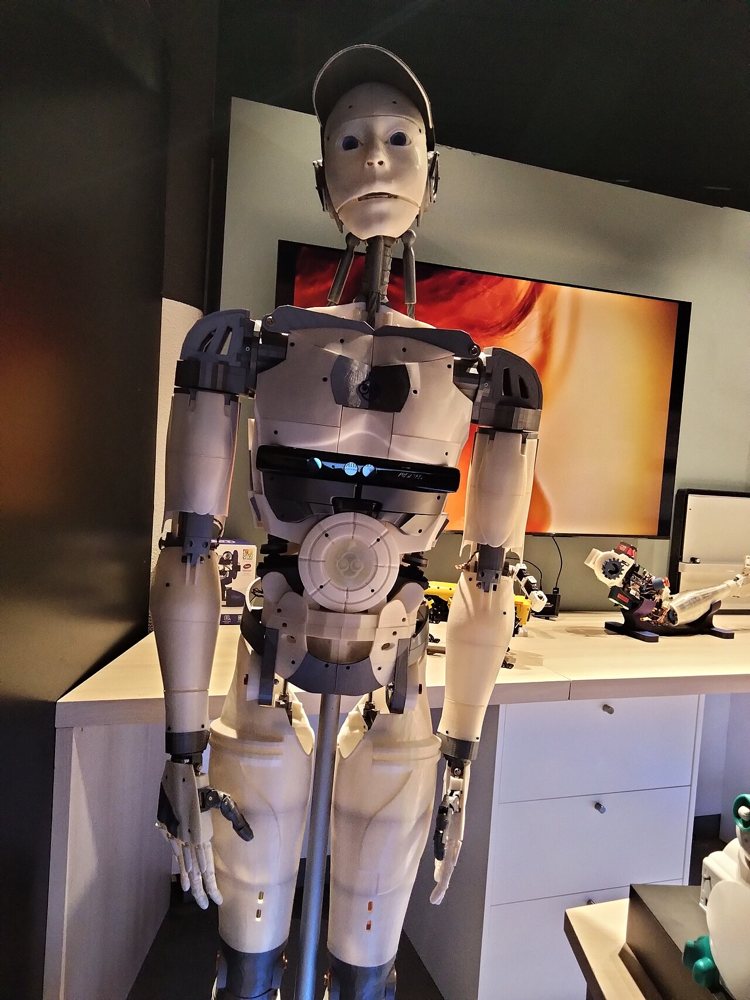 InMoovInMoov (Gael Langevin)Same job: research · Both fixed in place · Both research platforms InMoovInMoov (Gael Langevin)Same job: research · Both fixed in place · Both research platforms |
|---|---|---|
| First shown | 2016-04 | 2012-01 |
| Status | Research | Research |
| Height | — | — |
| Weight | — | — |
| Joints | — | — |
| Speed | — | — |
| Payload | — | — |
| Battery | — | — |
| Price | — | $1,500 |
Sources
Figures come from press coverage. Every link below backs something on this page.
Photos and logos only identify each robot and its maker. Simbeing is not affiliated with, sponsored by or endorsing any company, and nothing here is advertising. Figures are for statistics only and are not advice of any kind. Terms of use