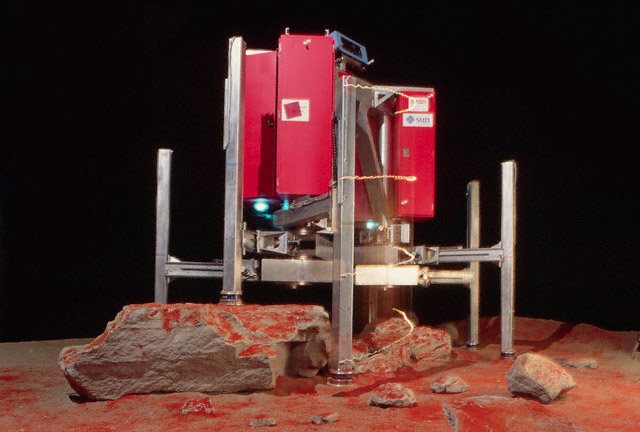
Carnegie Mellon University Field Robotics Center · legged machine
Ambler
A huge six-legged autonomous walker built from 1988 to test whether legged rovers suit Mars-like terrain. Its telescoping vertical legs kept its body level while it walked very slowly.
- Price
- —Not published
- Height
- 350 cmTaller than 91%
- Weight
- 2500 kgHeavier than 88%
- Payload
- —Not published
- Speed
- —Not published
- Battery
- —Not published
Not sure this is the one? Find the best robot for your job Starts with: research and teaching. Five more quick questions.
Why it matters
Used a unique 'circulating gait' in which trailing legs swung past the body to the front, and walked autonomously over boulders for NASA in 1990.
Real-world use
NASA planetary-exploration research
Timeline
- Released
- Not yet
Maker
Carnegie Mellon University Field Robotics CenterUniversity lab · Pittsburgh, Pennsylvania, USAHow it stacks up
Against other legged & novel that publish the figure. Pick a measure.
Ambler is taller than 91% of the 22 other legged & novel that publish a height. Bars show the 7 closest in date.
Ambler is heavier than 88% of the 25 other legged & novel that publish a weight. Bars show the 7 closest in date.
Not published by the maker: speed, payload, joints, battery, price.
Public attention
A historic robot: no longer sold or in use, so it is not ranked against current machines.
- No Wikipedia article of its own yet
- No recent press stories listed yet
Measures how much people read and write about a robot, not how good it is. Measured 2026-10-14; same method for every robot. How it is measured
What’s inside
The parts the company has talked about publicly.
- Movement
- Walks on legs
- How it runs
- Fully autonomous. It walked by itself, planning its own footholds and route from laser scans of the terrain, while researchers monitored the tests.
- Actuators & motors
- Six orthogonal legs that swing horizontally and telescope vertically; the rear leg could pass all others.
- Sensors & vision
- Laser rangefinder used to build terrain maps (kept level by the upright body).
- Battery & power
- Drew about 1,400 W standing and about 4,000 W walking (reported).
- AI & software
- Autonomous terrain mapping, footstep planning and balance control.
- Other details
- About 3.5 m tall (other accounts say about 5 m), up to 7 m wide and 2,500 kg; walked about 35 cm per minute and could step over 1 m obstacles.
Lineage
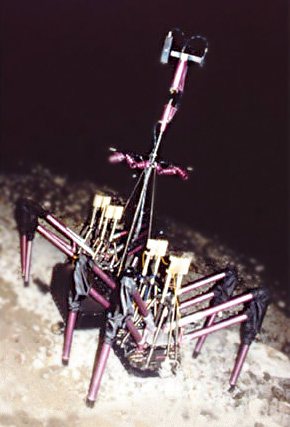
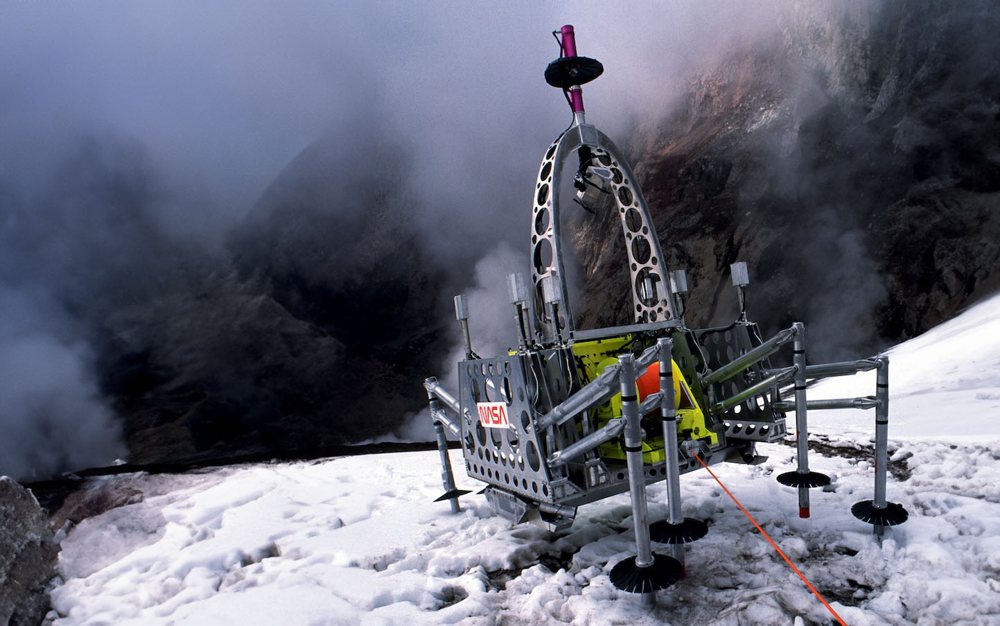
Every Carnegie Mellon University Field Robotics Center (with NASA JPL) machine in order.
Made, sold and where
Unit counts are usually company figures; analysts often disagree.
- Price
- Not published
- How to get one
- No official buying page found
- Built
- One research testbed
- Sold or delivered
- not sold
- Where it is sold or used
- Carnegie Mellon University Field Robotics Center, Pittsburgh (with NASA JPL)
- Customers and pilots
- NASA planetary-exploration research
Sources
Figures come from press coverage. Every link below backs something on this page.
Photos and logos only identify each robot and its maker. Simbeing is not affiliated with, sponsored by or endorsing any company, and nothing here is advertising. Figures are for statistics only and are not advice of any kind. Terms of use