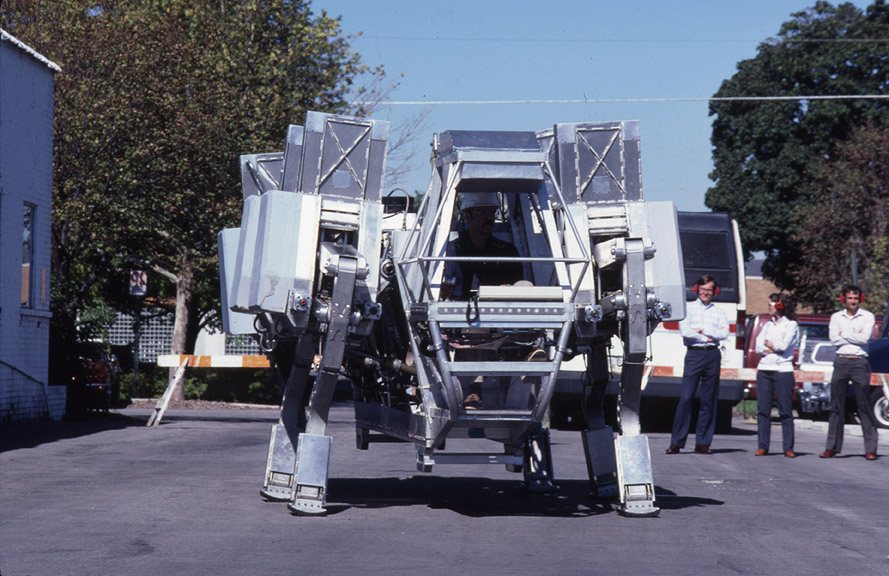
Ohio State University · legged machine
Adaptive Suspension Vehicle
ASV
A three-tonne, six-legged walker funded by DARPA from 1981, powered by a 900cc motorcycle engine driving hydraulic pumps. It took its first steps in late 1985 and the programme ended around 1990.
- Price
- —Not published
- Height
- 300 cmTaller than 82%
- Weight
- 2700 kgHeavier than 92%
- Payload
- 220 kgCarries more than 56%
- Speed
- 13.0 km/hFaster than 89%
- Battery
- —Not published
Not sure this is the one? Find the best robot for your job Starts with: research and teaching. Five more quick questions.
Why it matters
One of the largest computer-coordinated walking machines ever built: a rider steered while 17 onboard computers placed its six legs.
Real-world use
DARPA / US Army research programme (1981-1990)
Maker
Ohio State UniversityUniversity lab · Columbus, Ohio, USADARPA (about $1 million a year, reported)
How it stacks up
Against other legged & novel that publish the figure. Pick a measure.
Adaptive Suspension Vehicle (ASV) is taller than 82% of the 22 other legged & novel that publish a height. Bars show the 7 closest in date.
Adaptive Suspension Vehicle (ASV) is heavier than 92% of the 25 other legged & novel that publish a weight. Bars show the 7 closest in date.
Adaptive Suspension Vehicle (ASV) is faster than 89% of the 19 other legged & novel that publish a speed. Bars show the 7 closest in date.
Adaptive Suspension Vehicle (ASV) carries more than 56% of the 9 other legged & novel that publish a payload. Bars show the 7 closest in date.
Not published by the maker: joints, battery, price.
Public attention
A historic robot: no longer sold or in use, so it is not ranked against current machines.
- No Wikipedia article of its own yet
- 2 news stories from reputable press listed on this page
Measures how much people read and write about a robot, not how good it is. Measured 2026-10-14; same method for every robot. How it is measured
What’s inside
The parts the company has talked about publicly.
- Movement
- Walks on legs
- How it runs
- Assisted. A driver in the cab steered with a joystick while onboard computers placed the six legs and kept the body level.
- Actuators & motors
- Two-stage hydraulic system: a 900 cc motorcycle engine (about 91 hp) and a flywheel drive 18 variable-displacement pumps (three per leg); pantograph legs.
- Sensors & vision
- 82 sensed control variables; foot pressure sensors; a 128x128-pixel scanning rangefinder above the cab for footing selection.
- Compute
- 17 Intel 86/30 single-board computers (six for the legs); about 150,000 lines of Pascal.
- AI & software
- Supervisory control by an on-board operator using joystick and keypad; six modes including precision footing, terrain following and cruise/dash.
- Other details
- About 5.2 m long, 2.7 t, 220 kg payload; cruise about 2.25 m/s, maximum 3.6 m/s (reported). DARPA funded roughly $1 million a year.
From the maker
Adaptive Suspension Vehicle (ASV) is the only machine from Ohio State University in the atlas.
Made, sold and where
Unit counts are usually company figures; analysts often disagree.
- Price
- Not published
- How to get one
- No official buying page found
- Built
- One research vehicle
- Sold or delivered
- not sold
- Where it is sold or used
- Ohio State University, Columbus, Ohio
- Customers and pilots
- DARPA / US Army research programme (1981-1990)
News
The latest 2, newest first. Summaries are ours; tap through for the original.
- Gigazine revisits the Army's six-legged walker
Gigazine described the 1980s Army and Ohio State project to build a giant six-legged walking vehicle.
GIGAZINE - The Drive on the 1980s walking truck
The Drive recounted how DARPA and Ohio State built the ASV, detailing its engine, flywheel, pumps and 17 computers.
The Drive
Sources
Figures come from press coverage. Every link below backs something on this page.
Photos and logos only identify each robot and its maker. Simbeing is not affiliated with, sponsored by or endorsing any company, and nothing here is advertising. Figures are for statistics only and are not advice of any kind. Terms of use