KAIST (Korea Advanced Institute of Science and Technology) · research humanoid
KHR-2
KAIST's first complete humanoid, following the headless, handless KHR-1 (2002-03); it walked at about 1.2 km/h and led directly to HUBO (KHR-3) in 2005.
- Price
- —Not published
- Height
- 120 cmTaller than 12%
- Weight
- 56 kgHeavier than 42%
- Payload
- —Not published
- Speed
- 1.2 km/hFaster than 7%
- Battery
- —Not published
Not sure this is the one? Find the best robot for your job Starts with: research and teaching. Five more quick questions.
Why it matters
A retired humanoid from KAIST Hubo Lab (Jun-Ho Oh).
Real-world use
No customers or deployments reported yet.
Timeline
- First shown
- 2004
- Released
- Not yet
Maker
KAIST (Korea Advanced Institute of Science and Technology)University lab · Daejeon, South KoreaAgency for Defense Development (5.7 billion won for Pibot)
How it stacks up
Against other humanoids that publish the figure. Pick a measure.
KHR-2 is taller than 12% of the 305 other humanoids that publish a height. Bars show the 7 closest in date.
KHR-2 is heavier than 42% of the 277 other humanoids that publish a weight. Bars show the 7 closest in date.
KHR-2 is faster than 7% of the 122 other humanoids that publish a speed. Bars show the 7 closest in date.
Not published by the maker: payload, joints, battery, price.
Public attention
A historic robot: no longer sold or in use, so it is not ranked against current humanoids.
- No Wikipedia article of its own yet
- 3 news stories from reputable press listed on this page
Measures how much people read and write about a robot, not how good it is. Measured 2026-10-14; same method for every robot. How it is measured
What’s inside
The parts the company has talked about publicly.
- Movement
- Walks on legs
- Actuators & motors
- Electric servo motors driven by microprocessor-based sub-controllers, with joints designed to reduce backlash; 41 DoF in total (6 per leg, 4 per arm, 2 per wrist, 5 per hand, 6 in the head, 1 in the trunk).
- Hands
- 5 DoF per hand (finger joints), per the KAIST paper.
- Sensors & vision
- 3-axis force/torque sensors at the feet and wrists, an inertial sensor (accelerometer and rate gyro) and a CCD camera; the authors call the foot F/T sensor vital for stable walking.
- Compute
- Main controller on the robot's back talking to distributed joint sub-controllers over a CAN bus.
- Materials & build
- 120 cm, 56 kg; designed for a human-friendly look and wide joint ranges.
- AI & software
- Windows XP with the RTX real-time extension on the main controller.
- Other details
- Developed from 2003, after the headless, handless KHR-1; walking speed about 1.2 km/h.
Lineage
Every KAIST Hubo Lab (Jun-Ho Oh) humanoid in order.
- No public photo yetWe only show photos we're allowed to useKHR-22004Retired
 HUBO (KHR-3)2004Retired
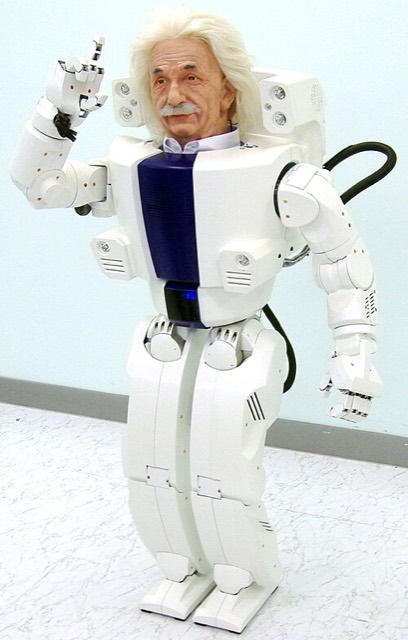 Albert HUBO2005Discontinued
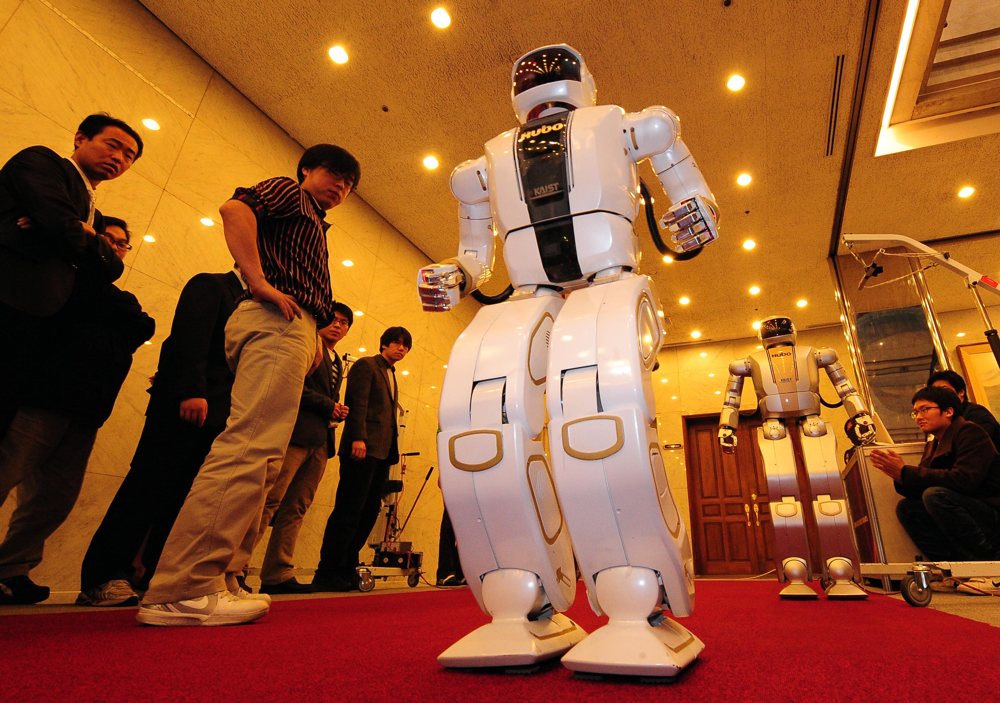 HUBO 2 (KHR-4)2008Discontinued
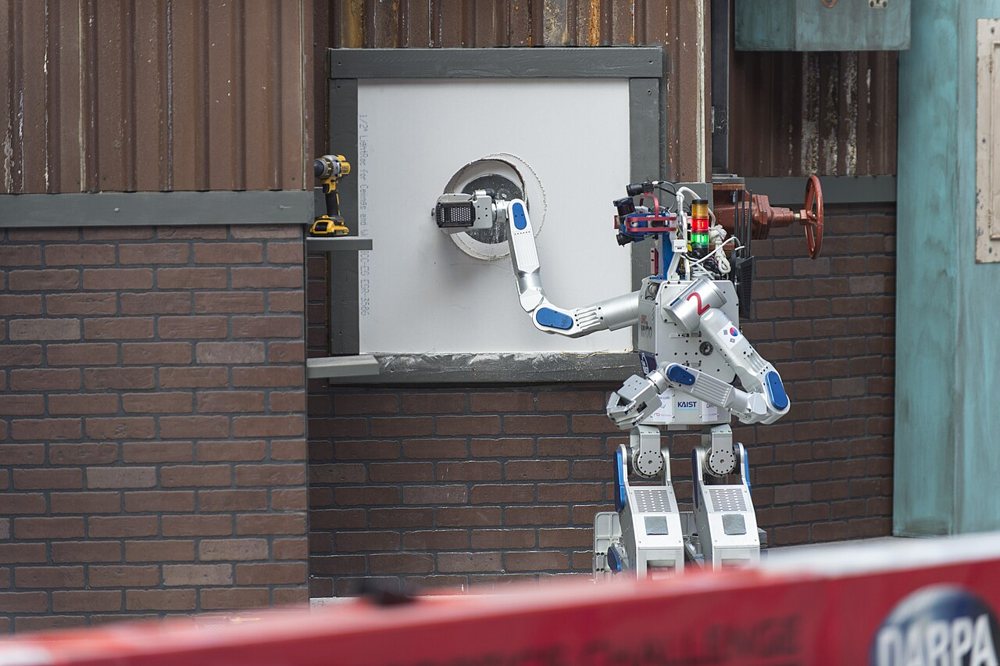 DRC-HUBO2015Retired
 Pibot2023Prototype
KAIST (Korea Advanced Institute of Science and Technology) also makes 1 machine. See every KAIST (Korea Advanced Institute of Science and Technology) robot
Made, sold and where
Unit counts are usually company figures; analysts often disagree.
- Price
- Not published
- How to get one
- No official buying page found
- Built
- Not stated (research prototype)
- Sold or delivered
- Not sold; research robot
- Where it is sold or used
- KAIST Humanoid Robot Research Center, Daejeon, South Korea
News
The latest 3, newest first. Summaries are ours; tap through for the original.
- Journal paper documents KHR-2
The International Journal of Humanoid Robotics published KAIST's full description of KHR-2's mechanics, electronics and control.
World Scientific (via Crossref) - Successor HUBO (KHR-3) launched
KAIST unveiled HUBO, the next step after KHR-2.
Wikipedia - KHR-2 presented at IEEE Humanoids 2004
Park, Kim, Park and Oh presented KHR-2 at the 4th IEEE-RAS International Conference on Humanoid Robots.
Crossref (IEEE record)
Side by side with its peers
Picked by the same rules for every humanoid: another maker’s robot that moves the same way, is at the same stage and does at least one of the same main jobs, first shown within two years. Closer size and price rank higher. How we choose
| Measure | No public photo yetWe only show photos we're allowed to useKHR-2KAIST Hubo Lab (Jun-Ho Oh) | 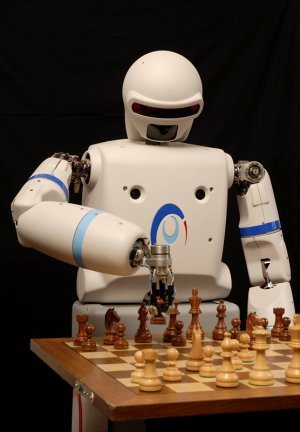 REEM-APAL RoboticsSame job: research · Both walk · Both past robots · Similar size REEM-APAL RoboticsSame job: research · Both walk · Both past robots · Similar size | No public photo yetWe only show photos we're allowed to useGuRooUniversity of Queensland Mobile Robotics LaboratorySame job: research · Both walk · Both past robots · Similar size | No public photo yetWe only show photos we're allowed to useCB2 (Child-robot with Biomimetic Body)Osaka UniversitySame job: research · Both walk · Both past robots · Similar size |
|---|---|---|---|---|
| First shown | 2004 | 2005 | 2002 | 2006 |
| Status | Retired | Retired | Retired | Retired |
| Height | 120 cm | 140 cm | 120 cm | 130 cm |
| Weight | 56 kg | 49 kg | — | 33 kg |
| Joints | — | 30 | 23 | — |
| Speed | 1.2 km/h | 1.5 km/h | — | — |
| Payload | — | 2 kg | — | — |
| Battery | — | 1.5 h | — | — |
| Price | — | — | — | — |
Sources
Figures come from press coverage. Every link below backs something on this page.
Photos and logos only identify each robot and its maker. Simbeing is not affiliated with, sponsored by or endorsing any company, and nothing here is advertising. Figures are for statistics only and are not advice of any kind. Terms of use