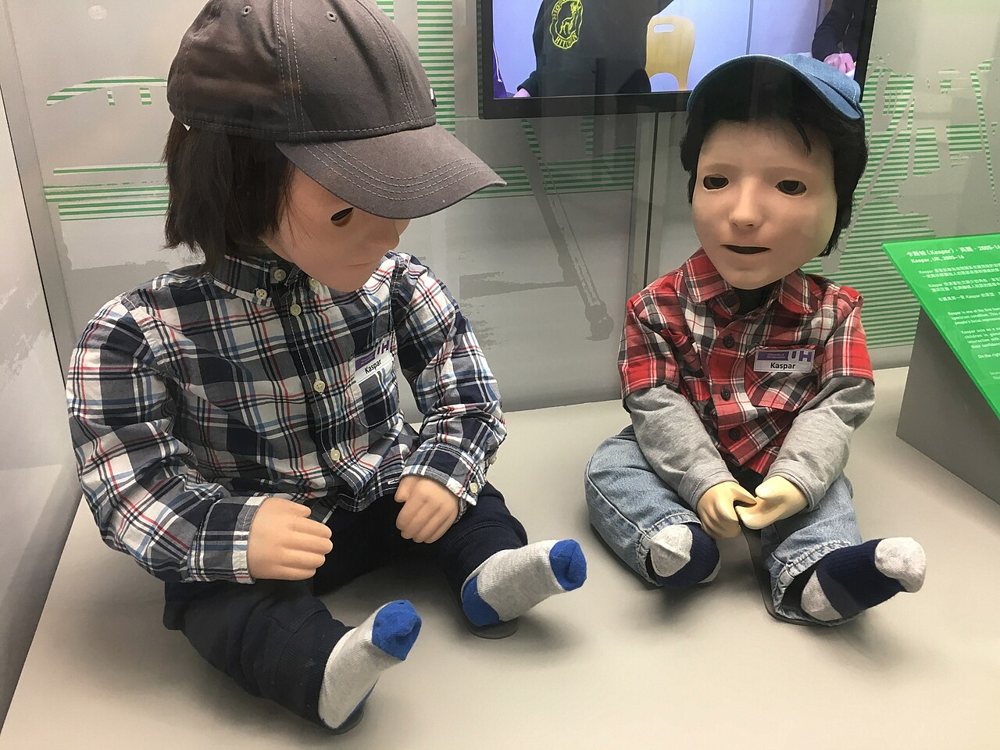
University of Hertfordshire · research humanoid
Kaspar
A seated child-sized robot with a simplified, expressive face and two arms, used in therapy and play with autistic children; it can run autonomously or by remote control. Included despite being under 60 cm (seated) because it is a long-running assistive robot, not a toy.
- Price
- —Not published
- Height
- —Not published
- Weight
- —Not published
- Payload
- —Not published
- Speed
- —Not published
- Battery
- —Not published
Not sure this is the one? Find the best robot for your job Starts with: care and hospitals. Five more quick questions.
Why it matters
A research humanoid from University of Hertfordshire.
Real-world use
Used for years in robot-assisted therapy sessions with autistic children.
Timeline
- First shown
- 2005
- Released
- Not yet
Maker
University of HertfordshireUniversity lab · founded 1952 · Hatfield, United KingdomPublic university; the Kaspar project received a 180,000-pound donation in 2012
How it stacks up
Against other humanoids that publish the figure. Pick a measure.
Kaspar has more joints than 3% of the 236 other humanoids that publish a joints. Bars show the 7 closest in date.
Not published by the maker: height, weight, speed, payload, battery, price.
What it has been shown doing
We checked public videos and press for Kaspar and found no clear demo of the skills we track yet.
Public attention
How much public attention Kaspar gets, from open data.
- No Wikipedia article of its own yet
- 2 news stories from reputable press listed on this page
Measures how much people read and write about a robot, not how good it is. Measured 2026-10-14; same method for every robot. How it is measured
What’s inside
The parts the company has talked about publicly.
- Movement
- Stationary · 17 joints
- Actuators & motors
- Dynamixel AX-12A smart servos and RC servos; 17 DoF (4 per arm, neck 3, mouth 2, eyes 2, eyelids 1, torso 1).
- Hands
- No functional hands; arms with 4 DoF each.
- Sensors & vision
- Cameras built into the eyes; force-sensing resistor or capacitive touch sensors under the skin so children's touch can trigger responses.
- Compute
- Run from an external PC over USB, or wirelessly via an on-board mini PC.
- Battery & power
- One 12 V, 7 Ah lead-acid battery, about 4 hours of operation.
- Materials & build
- Fibreglass body, aluminium frame and head parts, silicone rubber face with simplified features; 55 cm tall seated, 15 kg.
- AI & software
- Custom Java software with optional YARP, C++ and Python interfaces; can run autonomously or be remote-controlled by a therapist.
- Other details
- Designed for robot-assisted play and therapy with autistic children; head design led by Kerstin Dautenhahn and Chrystopher Nehaniv, body supervised by Michael L. Walters, therapy work by Ben Robins.
Named suppliers:ROBOTIS (Dynamixel)
From the maker
Kaspar is the only humanoid from University of Hertfordshire in the atlas.
Watch Kaspar
Made, sold and where
Unit counts are usually company figures; analysts often disagree.
- Price
- Not published
- How to get one
- No official buying page found
- Built
- Not stated
- Sold or delivered
- Not sold commercially
- Where it is sold or used
- University of Hertfordshire, Hatfield, UK
- Customers and pilots
- Used in autism therapy and human-robot interaction studies; named schools or clinics not found
News
The latest 2, newest first. Summaries are ours; tap through for the original.
- KASPAR project for children with autism — foundation funding
The university records £180,000 of Stavros Niarchos Foundation funding for the Kaspar autism project running from August 2011 to July 2016.
University of Hertfordshire - The Iterative Development of the Humanoid Robot Kaspar: An Assistive Robot for Children with Autism
The first Kaspar prototype was developed in 2005 as a human–robot interaction research platform and subsequently adopted for autism research.
University of Hertfordshire
Side by side with its peers
Picked by the same rules for every humanoid: another maker’s robot that moves the same way, is at the same stage and does at least one of the same main jobs, first shown within two years. Closer size and price rank higher. Few robots match closely, so these are the nearest matches. How we choose
| Measure | KasparUniversity of Hertfordshire | 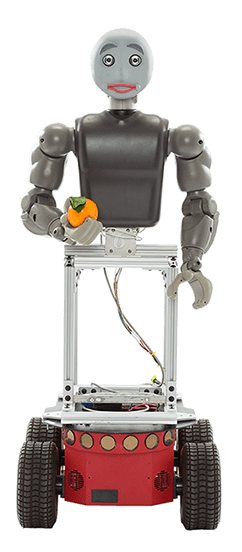 BanditUSC Interaction Lab and BlueSky RoboticsSame job: care · Both fixed in place · Both research platforms BanditUSC Interaction Lab and BlueSky RoboticsSame job: care · Both fixed in place · Both research platforms |
|---|---|---|
| First shown | 2005 | 2006 |
| Status | Research | Research |
| Height | — | 56 cm |
| Weight | — | 7.7 kg |
| Joints | 17 | 19 |
| Speed | — | — |
| Payload | — | — |
| Battery | — | — |
| Price | — | $15,000 |
Sources
Figures come from press coverage. Every link below backs something on this page.
Photos and logos only identify each robot and its maker. Simbeing is not affiliated with, sponsored by or endorsing any company, and nothing here is advertising. Figures are for statistics only and are not advice of any kind. Terms of use