University of Zurich AI Lab · research humanoid
Roboy
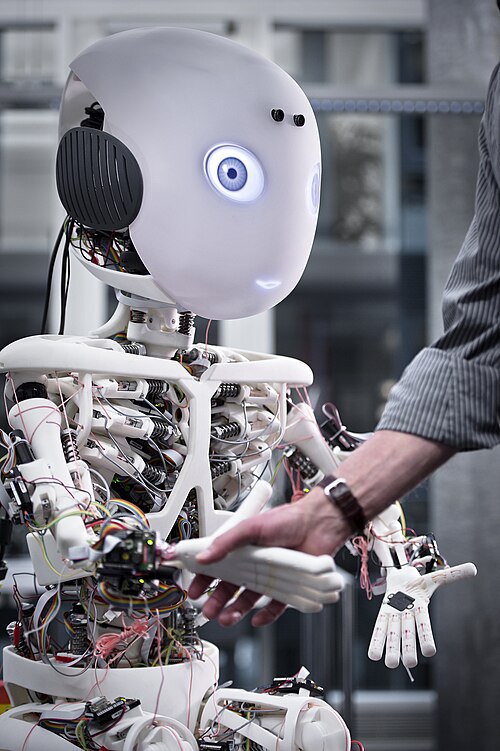
A child-sized, largely 3D-printed humanoid with artificial muscles and tendons and open hardware and software, built as a research platform for human-like muscle actuation; it can understand speech and detect faces.
- Price
- —Not sold.
- Height
- 130 cmTaller than 19%
- Weight
- —Not published
- Payload
- —Not published
- Speed
- —Not published
- Battery
- —Not published
Not sure this is the one? Find the best robot for your job Starts with: research and teaching. Five more quick questions.
Why it matters
A retired humanoid from University of Zurich AI Lab.
Real-world use
No customers or deployments reported yet.
Timeline
- Released
- Not yet
Maker
University of Zurich AI LabUniversity lab · Zurich, Switzerlandpublic university lab; Roboy funded partly by crowdfunding and sponsors
How it stacks up
Against other humanoids that publish the figure. Pick a measure.
Roboy is taller than 19% of the 305 other humanoids that publish a height. Bars show the 7 closest in date.
Roboy has more joints than 39% of the 236 other humanoids that publish a joints. Bars show the 7 closest in date.
Not published by the maker: weight, speed, payload, battery, price.
Public attention
A historic robot: no longer sold or in use, so it is not ranked against current humanoids.
- 258 views of its Wikipedia article in the last 90 days (Roboy)
- 3 news stories from reputable press listed on this page
Measures how much people read and write about a robot, not how good it is. Measured 2026-10-14; same method for every robot. How it is measured
What’s inside
The parts the company has talked about publicly.
- Movement
- Stationary · 28 joints
- Actuators & motors
- 48 Maxon brushless DC motors with EPOS 2 controllers pulling artificial tendons, with series elastic springs for compliance; 28 DoF (head 3, spine/chest 3, arms 6 each, hands 1 each, legs 4 each).
- Hands
- Capacitive sensors in Roboy's palms detect an approaching human hand and trigger a handshake (Baumer, 2013).
- Sensors & vision
- Two cameras (stereo) and a microphone in the head; force/tension sensors in most motors; relative encoders and a custom absolute position sensor.
- Compute
- Intel-based main computer, either an on-board mini PC or an external PC, plus 48 ARM-based motor controller boards.
- Battery & power
- Runs from a standard power supply or batteries; no battery specs published.
- Materials & build
- Most of the skeleton 3D-printed in SLS polyamide; a soft skin was planned.
- AI & software
- Ubuntu, Festival speech synthesis, OpenCV, MPlayer and custom C++; hardware and software released as open source. Understands speech and detects faces.
- Other details
- Built in about nine months with crowdfunding; backers' names were engraved on the robot. Later work involved the EU Myorobotics project, the Human Brain Project and TU Munich.
Named suppliers:maxon
From the maker
Roboy is the only humanoid from University of Zurich AI Lab in the atlas.
Made, sold and where
Unit counts are usually company figures; analysts often disagree.
- Price
- Not publishedNot sold.
- How to get one
- No official buying page found
- Sold or delivered
- not sold; total project cost about $500,000, about $120,000 estimated to reproduce
- Where it is sold or used
- AI Lab, University of Zurich, Switzerland (later developed in Garching near Munich)
News
The latest 3, newest first. Summaries are ours; tap through for the original.
- Roboy 3.0 unveiled
The project unveiled a third-generation Roboy on 28 October 2020 before moving toward commercial 'Robody' robots.
Roboy project - Baumer Sensors Monitor Movement of "Roboy"
Baumer's case study dates Roboy's introduction at Robots on Tour in Zurich to March 8, 2013 and describes its tendon drive and handshake sensors.
Automation.com (Baumer Ltd. case study) - Zurich AI Lab races to finish Roboy
Phys.org reported the crowdfunded, tendon-driven robot was being assembled for a March 2013 unveiling.
Phys.org
Side by side with its peers
Picked by the same rules for every humanoid: another maker’s robot that moves the same way, is at the same stage and does at least one of the same main jobs, first shown within two years. Closer size and price rank higher. Few robots match closely, so these are the nearest matches. How we choose
| Measure | RoboyUniversity of Zurich AI Lab | 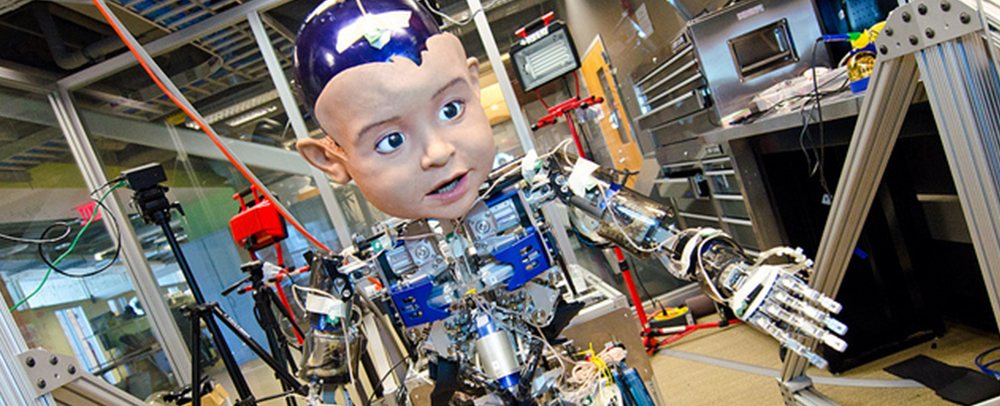 Diego-sanUC San Diego Machine Perception Lab with Kokoro and Hanson RoboticsSame job: research · Both fixed in place · Both past robots · Similar size Diego-sanUC San Diego Machine Perception Lab with Kokoro and Hanson RoboticsSame job: research · Both fixed in place · Both past robots · Similar size | 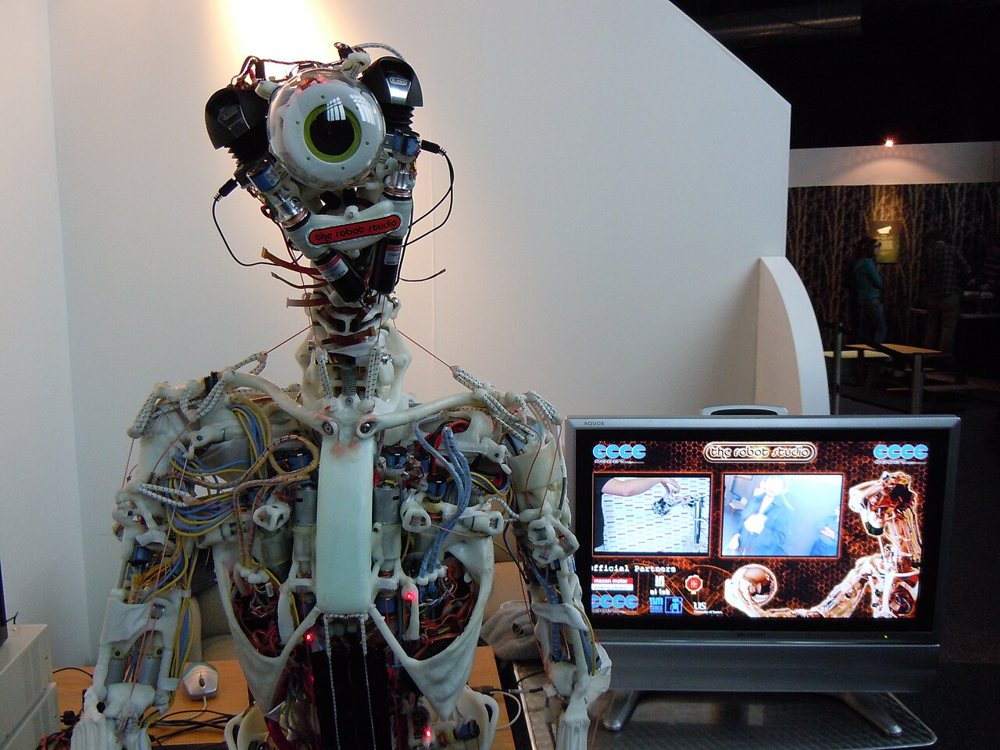 ECCE (ECCEROBOT)The Robot Studio and the EU ECCEROBOT projectSame job: research · Both fixed in place · Both past robots · Similar size ECCE (ECCEROBOT)The Robot Studio and the EU ECCEROBOT projectSame job: research · Both fixed in place · Both past robots · Similar size | 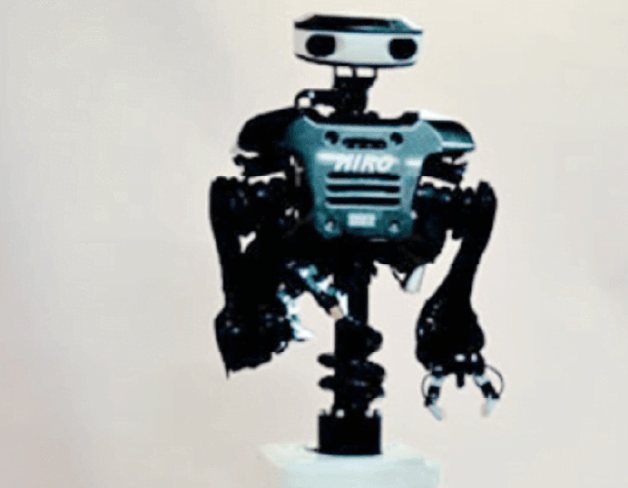 HIROKawada IndustriesSame job: research · Both fixed in place · Both past robots HIROKawada IndustriesSame job: research · Both fixed in place · Both past robots |
|---|---|---|---|---|
| First shown | 2013-03-08 | 2013-01 | 2009-11 | 2009 |
| Status | Retired | Discontinued | Retired | Discontinued |
| Height | 130 cm | 130 cm | 105 cm | — |
| Weight | — | 30 kg | 26 kg | — |
| Joints | 28 | 62 | 60 | — |
| Speed | — | — | — | — |
| Payload | — | — | — | — |
| Battery | — | — | — | — |
| Price | — | — | — | — |
Sources
Figures come from press coverage. Every link below backs something on this page.
Photos and logos only identify each robot and its maker. Simbeing is not affiliated with, sponsored by or endorsing any company, and nothing here is advertising. Figures are for statistics only and are not advice of any kind. Terms of use