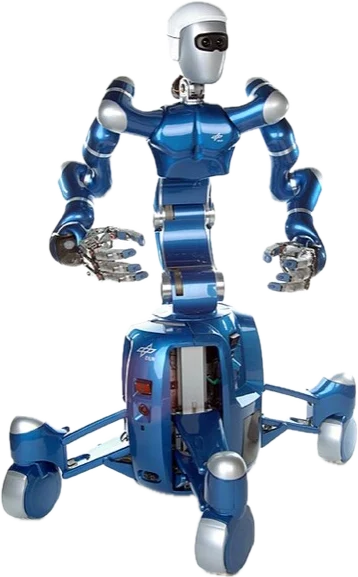
German Aerospace Center (DLR), Institute of Robotics and Mechatronics · research humanoid
Rollin' Justin
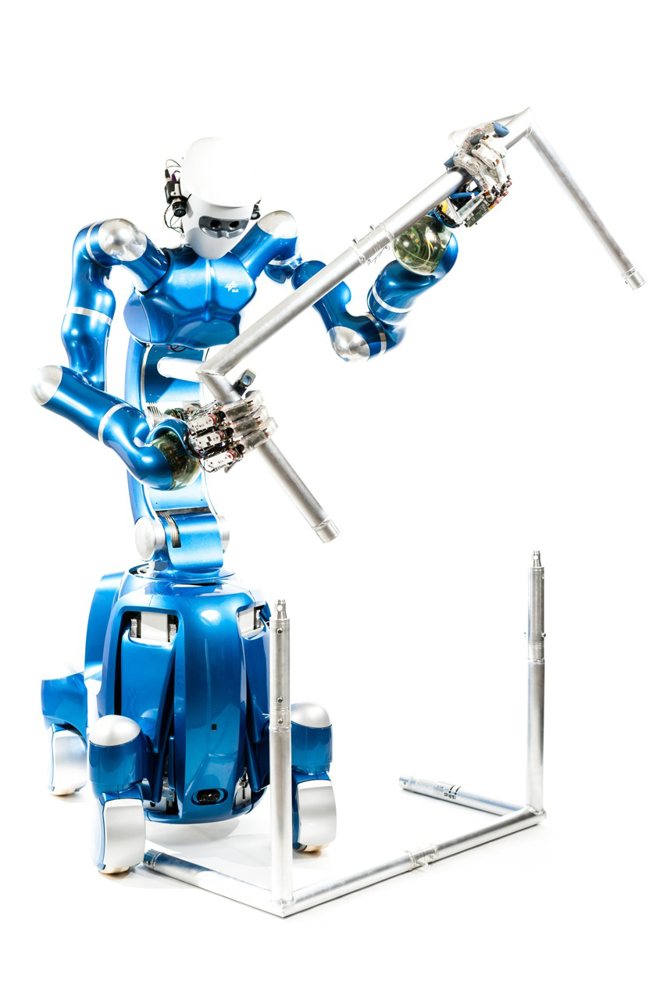
DLR's Justin upper body (2006) mounted on a four-wheeled base with a variable footprint, giving a 1.91 m robot with 12-DOF hands that can catch balls and make coffee. DLR lists operating time as more than 60 minutes.
- Price
- —Not published
- Height
- 191 cmTaller than 98%
- Weight
- 200 kgHeavier than 97%
- Payload
- 20 kgCarries more than 72%
- Speed
- 7.2 km/hFaster than 77%
- Battery
- 1 hRuns longer than 3%
Not sure this is the one? Find the best robot for your job Starts with: help at home. Five more quick questions.
Why it matters
A leading torque-controlled two-arm humanoid; in 2017 it was teleoperated from the International Space Station in a simulated Mars setting.
Real-world use
Used in DLR space telerobotics experiments controlled from the ISS.
Timeline
- Released
- Not yet
Maker
German Aerospace Center (DLR), Institute of Robotics and MechatronicsGovernment lab · founded 1969 · Cologne, GermanyGovernment-funded; total DLR funding EUR 1.701 billion in 2024 (52.9% government, 47.1% third-party)
How it stacks up
Against other humanoids that publish the figure. Pick a measure.
Rollin' Justin is taller than 98% of the 305 other humanoids that publish a height. Bars show the 7 closest in date.
Rollin' Justin is heavier than 97% of the 277 other humanoids that publish a weight. Bars show the 7 closest in date.
Rollin' Justin is faster than 77% of the 122 other humanoids that publish a speed. Bars show the 7 closest in date.
Rollin' Justin carries more than 72% of the 132 other humanoids that publish a payload. Bars show the 7 closest in date.
Rollin' Justin has more joints than 84% of the 236 other humanoids that publish a joints. Bars show the 7 closest in date.
Rollin' Justin runs longer than 3% of the 119 other humanoids that publish a battery. Bars show the 7 closest in date.
Not published by the maker: price.
What it has been shown doing
1 of 14 skills we track, each from a public video or report. Demos can be staged or remote-controlled; we say so when the source does.
- Assemble partsperforms maintenance and assembly tasks on a simulated Mars solar farm, supervised by astronauts on the ISS · Aug 2018 · dlr.de
Not shown yet:SortFoldKitchenToolsFineStairsTerrainGet upRunJumpCarryOn siteAutonomous
Public attention
How much public attention Rollin' Justin gets, from open data.
- No Wikipedia article of its own yet
- 4 news stories from reputable press listed on this page
Measures how much people read and write about a robot, not how good it is. Measured 2026-10-14; same method for every robot. How it is measured
What’s inside
The parts the company has talked about publicly.
- Movement
- Wheeled base · 51 joints
- Actuators & motors
- Torque-controlled joints with 41 link-side torque sensors; arms and hands derive from the DLR Light-Weight Robot III and DLR Hand II (DLR).
- Hands
- Two four-fingered hands with 12 DoF each.
- Sensors & vision
- 43 position and 41 link-side torque sensors, two Prosilica cameras for stereo vision and five Asus Xtion motion-sensing devices (DLR METERON); two IMUs are also listed by DLR.
- Compute
- Four Mini-ITX boards with Intel Core i7 quad-core processors.
- Battery & power
- 52 V battery, about 1.5 hours; DLR lists more than 60 minutes.
- AI & software
- QNX real-time OS and Linux with custom control software; compliant hierarchical whole-body control and modular autonomous task planning (DLR).
- Other details
- Four-wheeled base with individually movable spring-mounted wheels that change its footprint; about 200 kg, 20 kg nominal payload, up to 2 m/s, reach from floor to 2.7 m (DLR).
Lineage
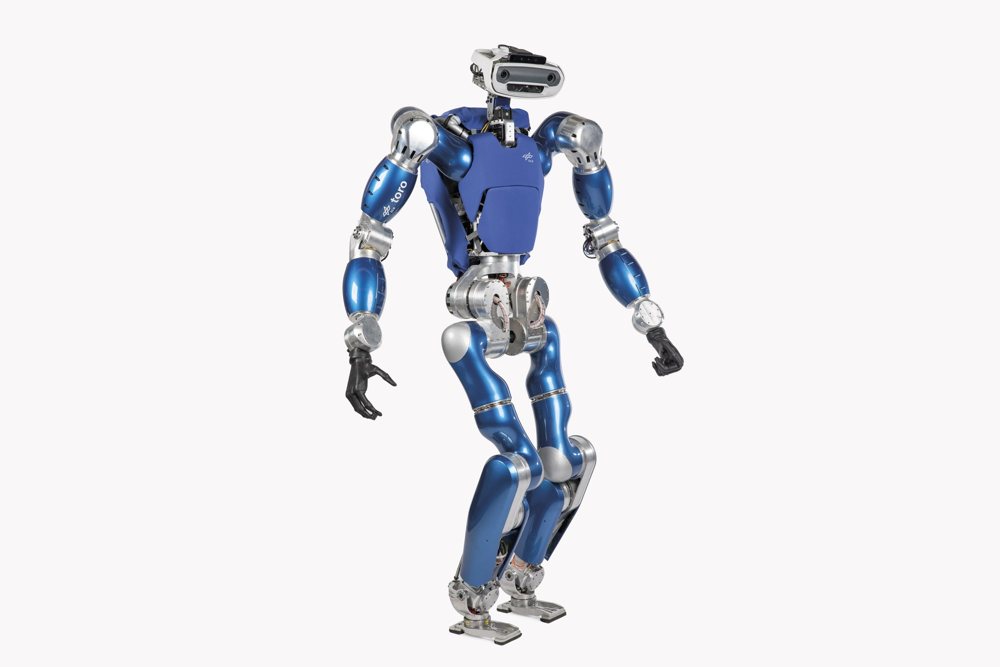
Every German Aerospace Center (DLR) humanoid in order.
Made, sold and where
Unit counts are usually company figures; analysts often disagree.
- Price
- Not published
- How to get one
- No official buying page found
- Built
- Research unit; count not published
- Where it is sold or used
- Germany
News
The latest 4, newest first. Summaries are ours; tap through for the original.
- ISS Crew have a blast with SUPVIS Justin!
From the ISS, Paolo Nespoli used a tablet to command Rollin’ Justin in DLR’s simulated Martian solar farm.
German Aerospace Center (DLR), METERON - Agile Justin: DLR’s Rollin’ Justin Gets a Younger, More Agile Brother — Pair Combines to Play Catch
DLR introduced Agile Justin with arms 1.5 times faster through revised gear ratios and coordinated motion for throwing balls.
Hizook - Catching Flying Balls and Preparing Coffee: Humanoid Rollin’Justin Performs Dynamic and Sensitive Tasks
Rollin’ Justin demonstrated ball catching with a success rate above 80% for typical feasible throws and autonomous coffee preparation.
German Aerospace Center (DLR) - Wheeled base debuts at Automatica 2008
Hizook reported the variable-footprint mobile base apparently debuted at the Automatica fair.
Hizook
Side by side with its peers
Picked by the same rules for every humanoid: another maker’s robot that moves the same way, is at the same stage and does at least one of the same main jobs, first shown within two years. Closer size and price rank higher. How we choose
| Measure | 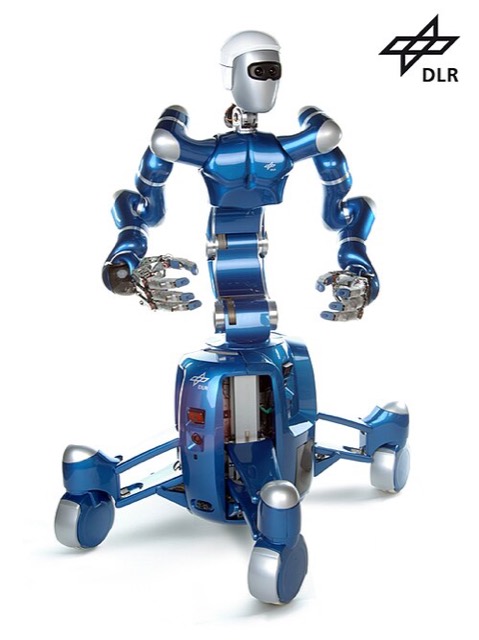 Rollin' JustinGerman Aerospace Center (DLR) Rollin' JustinGerman Aerospace Center (DLR) | 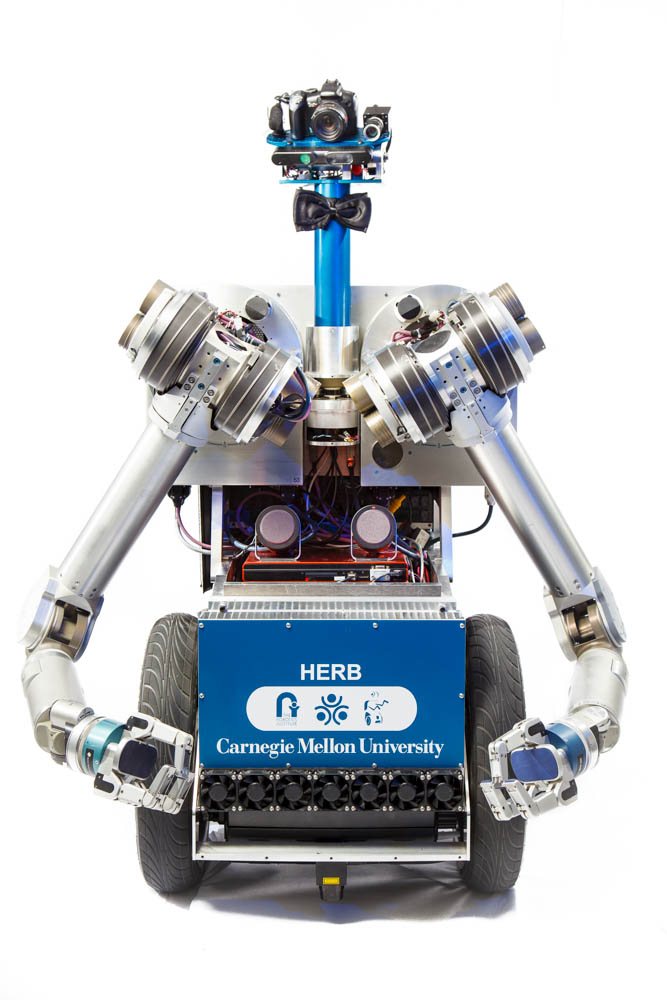 HERB (Home Exploring Robot Butler)Carnegie Mellon University (later University of Washington), Siddhartha Srinivasa labSame job: home · Both on wheels · Both research platforms HERB (Home Exploring Robot Butler)Carnegie Mellon University (later University of Washington), Siddhartha Srinivasa labSame job: home · Both on wheels · Both research platforms | 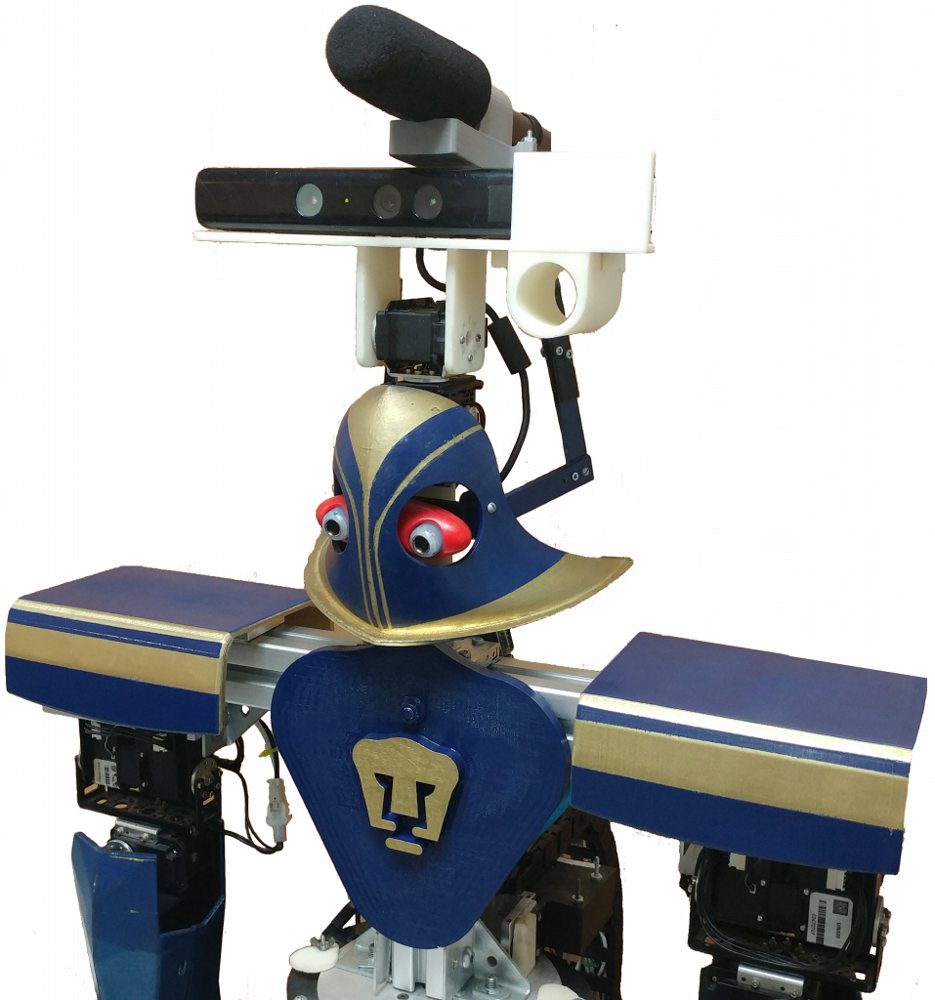 JustinaUNAM Bio-Robotics Laboratory, School of Engineering (team Pumas, Jesus Savage)Same job: home · Both on wheels · Both research platforms JustinaUNAM Bio-Robotics Laboratory, School of Engineering (team Pumas, Jesus Savage)Same job: home · Both on wheels · Both research platforms |
|---|---|---|---|
| First shown | 2008-06 | 2006 | 2006 |
| Status | Research | Research | Research |
| Height | 191 cm | — | — |
| Weight | 200 kg | — | — |
| Joints | 51 | — | — |
| Speed | 7.2 km/h | — | — |
| Payload | 20 kg | — | — |
| Battery | 1 h | — | — |
| Price | — | — | — |
Sources
Figures come from the maker. Every link below backs something on this page.
Photos and logos only identify each robot and its maker. Simbeing is not affiliated with, sponsored by or endorsing any company, and nothing here is advertising. Figures are for statistics only and are not advice of any kind. Terms of use